
PROMOTING EXCELLENT BEHAVIOUR
at
WICKLEA ACADEMY
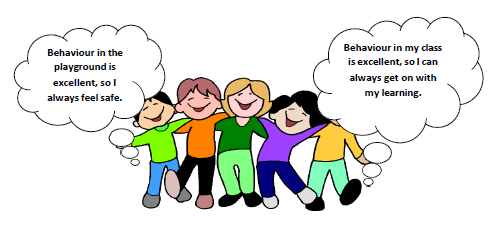
We want everyone to behave in an outstanding manner so that they can take part in outstanding learning.
RATIONALE
We believe that learning takes place best when children and adults feel safe and happy. Good behaviour in the classroom and throughout the academy is essential if this is to be the case.
AIMS AND EXPECTATIONS
At Wicklea Academy, we value every member of the Academy community. In our community, we want everyone to feel valued and respected, and to be treated fairly. We are a caring community, with values built on mutual trust and respect for all. This policy aims to promote an environment in which relationships are honest, caring and constructive and everyone feels happy and safe.
The primary aim of our Behaviour Policy is to promote good relationships, fostering consideration and respect for others. The child’s behaviour is seen as an expression of their feelings.
This policy aims to help children to grow in a safe and secure environment, and to become positive, responsible and increasingly independent members of the academy community where there is an ethos of kindness and co-operation.
We treat all children fairly and apply this behaviour policy in a consistent way. This policy is designed to celebrate positive behaviour and give strategies to children to support them in achieving this behaviour.
In order to promote good behaviour we;
· Develop children’s understanding of our values: Respectful, Ready, Resilient
· Teach our behaviour curriculum so everyone knows and follows our expectations and routines
· Ensure that all staff promote good behaviour through a common approach to behaviour, knowing out values, expectations and routines
· Consistently follow up when children are not showing our values, expectations or following out routines
· Frequently use praise and rewards
· Develop support programmes for pupils who are experiencing difficulty
OUR SCHOOL VALUES
Wicklea Academy has three values, which should be evident in every lesson, corridor and playground every day.
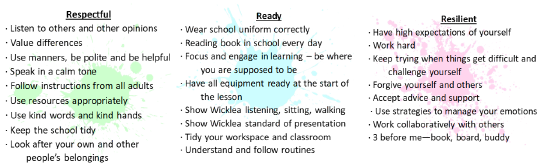
Our aim is ‘to enable our pupils to be independent, confident members of the community who are equipped with skills to be lifelong learners to engage with their dreams and aspirations’. The Wicklea Academy community very much believe that we are a team of adults and children who are all on a learning journey. We share the excitement of achieving and learning new things. We all have different strengths, interests and things we find difficult, because of this we believe passionately that Wicklea Academy will deliver a broad and balanced curriculum and a range of enrichment activities.
EQUAL OPPORTUNITIES
Incidents of racism, sexism, harassment, victimisation, sexualised behaviour and homophobia are dealt with very severely. The parents/carers of all involved are contacted immediately. All incidents are logged.
BULLYING
All children have the right to learn and work in an environment where they feel safe and that is free from harassment and bullying. As with racism, incidents where bullying is proven are dealt with very seriously. The parents/carers of all involved are contacted immediately (for further details please refer to the school’s anti-bullying policy).
REWARDS
You WILL be rewarded for great behaviour and showing our values! To reward children, we use:
We believe it is very important to frequently acknowledge and celebrate pupil achievement in all aspects of school life therefore; rewards are an extremely important part of Wicklea Academy.
CONSEQUENCES
We expect all our children to show our values, meet our expectations and follow our routines. If they choose not to then consequences are put in place. There are other behaviours that will not be tolerated.
Every time poor behaviour is seen, there will be a consequence. These might be:
The expectations and routines that we have at Wicklea are set out in our Behaviour Curriculum. Incidences of poor behaviour and not showing our values are recorded and the consequences are detailed below.
| Behaviour | Consequence – Staged Approach |
| Not showing the “Ready” value |
|
| Not showing the “Respectful” value |
|
| Continued not showing values or following behaviour expectations and routines
(Record on CPOMS) |
|
| Aggressive or intimidating behaviour in the classroom, including the use of discriminatory language
(Record on CPOMS) |
|
| Aggressive or intimidating behaviour on the playground, including the use of discriminatory language
(Record on CPOMS) |
|
| Serious disruption to learning or the smooth running of the school, e.g. leaving the classroom without permission, attempting to leave the school site, tipping tables, throwing objects, anything preventing the class teacher from teaching
Fighting with other pupils (Record on CPOMS) |
Internal suspension
Follow up conversation with senior leader and member of pastoral team Meeting with parents Next step discussion which may involve outside agencies |
| Continued serious disruption of learning Severe violence or abuse to an adult or other child
Behaving in a way that puts pupils or others at risk of harm (Record on CPOMS) |
Suspension
Meeting with parents Next step discussion which may involve outside agencies Possible exclusion |
If pupils are unresponsive to the consequences, the Family Link Worker along with a senior leader will meet the parents to create a Behaviour Support Plan. The SENDCO, class teacher, other relevant adults, parents/carers and child will all be involved in creating the plan, which will be reviewed regularly.
PARENT SUPPORT
Parental support is crucial to ensuring the best outcomes for all pupils. Positive behaviour patterns are more likely to be embedded if pupils know that all adults are working together to support them and respect is shown for school decisions. The school is well equipped to support or signpost parents who require support with their child’s behaviour. Ensuring pupils have good attendance and are punctual also supports positive behaviour and engagement.
PUPILS WORKING OUTSIDE OF THE BEHAVIOUR POLICY
Our behaviour policy may not meet the needs of all pupils, and some pupils may require an individual behaviour plan. These pupils may have special educational needs or social, emotional and mental health concerns. They may also be experiencing emotional difficulties as result of experiences in their life. In these cases, we may make reasonable adjustments from the school behaviour policy to support these pupils with their behaviour. However, a tailored approach should complement the whole school policy without lowering expectations of any pupil’s behaviour. A tailored plan will normally involve accessing support from outside agencies to support the pupil and their behaviour.
When a pupil is in a heightened emotional state (dysregulated), staff will endeavour to de-escalate and help the pupil to regulate their emotions by:
PHYSICAL INTERVENTION (POSITIVE HANDLING)
In exceptional circumstances, staff may use reasonable and proportionate physical intervention to prevent a pupil from:
Any use of physical intervention must be reasonable, necessary and proportionate to the level of risk presented. Restrictive physical intervention should only be used as a last resort, when other de-escalation and behaviour support strategies have been unsuccessful or are considered likely to be ineffective in preventing harm.
Physical intervention should only be carried out by staff who have received appropriate training, except in unforeseen emergency situations where immediate action is necessary to prevent injury or serious harm. The intervention must use the least restrictive option, applying the minimum force for the shortest time necessary, while preserving the safety, welfare and dignity of all those involved.
Physical intervention must never be used as a form of punishment, to cause pain, humiliation or distress, or solely to secure compliance with instructions.
All incidents involving restrictive physical intervention will be recorded promptly in the school’s bound and numbered book, internal recording system and reported to parents/carers as soon as practicable. Records will include the antecedents, the nature of the intervention, its duration, the outcome, and any follow-up actions required.